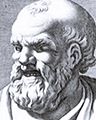
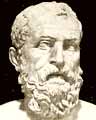
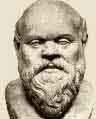
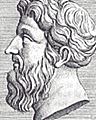
Quotes by
Thales of Miletus |
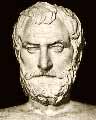 A pre-Socratic Greek philosopher, mathematician, and astronomer from Miletus in Asia Minor. He was one of the Seven Sages of Ancient Greece. Regarded as the first individual in Western civilization known to have entertained and engaged in scientific philosophy.
 | 24 quotes | 8,983 visits |
Quotations
| • | There are three attributes for which I am grateful to Fortune: that I was born, first, human and not animal; second, man and not woman; and third, Greek and not barbarian. 14 |
| • | Someone asked him if it would be possible to hide evil from the gods. He said, “Not even in your thoughts.” 13 |
| • | He said, “There’s no difference between Death and Life.” “So,” someone said, “Why don’t you just die?” “Because,” he said, “there’s no difference!” 12 |
| • | To the adulterer who wanted to know if he should swear he didn’t commit adultery, he said, “Adultery’s not worse than perjury.” 7 |
Ancient Greek
| • | The world is wonderful, because it is a creation of God. Κάλλιστον κόσμος, ποίημα γαρ θεού. 52 |
| • | Space is the greatest thing, as it contains all things. Μέγιστον τόπος. Άπαντα γαρ χωρεί. 22 |
| • | Mind is the swiftest of things, for it runs through everything. Τάχιστον νους, δια παντός γαρ τρέχει. 17 |
| • | It is difficult to know yourself; it is easy to give advice to others. Δύσκολον τον εαυτόν γνώναι, εύκολον τω άλλω υποτίθεσθαι. 17 |
| • | God is the most ancient of all things, for he had no birth. Πρεσβύτατον των όντων θεός, αγένητον γαρ. 15 |
| • | Since life is short, don’t make it long with bad deeds. Τον βίον μη, τω χρόνω βραχύν όντα, πράγμασιν κακοίς μακρόν ποιείν. 15 |
| • | Time is the wisest of all things that are; for it brings everything to light. Σοφώτατον χρόνος· ανευρίσκει γαρ πάντα. 11 |
| • | What’s divine? That which has neither beginning nor end. Τι το θείον; το μήτε αρχήν έχον μήτε τελευτήν. 10 |
| • | Death is no different at all from life. Ουδέν τον θάνατον διαφέρει του ζήν. 8 |
| • | Who is happy? This is a person, who has a healthy body, is dowered with peace of mind and cultivates his talents. Τις ευδαίμων; Ο το μεν σώμα υγιής, την δε ψυχήν εύπορος, την δε φύσιν ευπαίδευτος. 8 |
| • | All things are full of gods. Πάντα πλήρη θεών είναι. 7 |
| • | To the question, “What came first, night or day?” “Night,” he said, “by one day.” Τον πυθόμενον τι πρότερον γεγόνοι, νυξ η ημέρα, «η νυξ,» έφη, «μια ημέρα πρότερον.» 7 |
| • | How might one bear misfortune? To see your enemy doing even worse. Πώς αν τις ατυχίαν ράστα φέροι; 6 |
| • | A multitude of words is no proof of a prudent mind. Ου τι τα πολλά έπη φρονίμην απεφήνατο δόξαν. 6 |
| • | Avoid doing what you would blame others for doing. Εάν ά τοις άλλοις επιτιμώμεν, αυτοί μη δρώμεν 5 |
| • | Strongest is Necessity because it governs all things. Ισχυρότατον ανάγκη· κρατεί γαρ πάντων. 4 |
| • | Nothing is blameless, but all things have faults and imperfections. Ουδέν ανεπίληπτον, αλλ’ έχει πάντα διαμαρτίας και αγνοίας. 4 |
| • | What is the most pleasant thing? To succeed. Τι ήδιστον; το επιτυγχάνειν. 4 |
| • | What is common to all men? Hope. Because those who have nothing else possess hope still. Τι κοινότατον; Ελπίς. Και γαρ οίς άλλο μηδέν, αύτη παρέστη. 4 |
| • | Conceal thy domestic ills. Κακά εν οίκω κρύπτε. 4 |